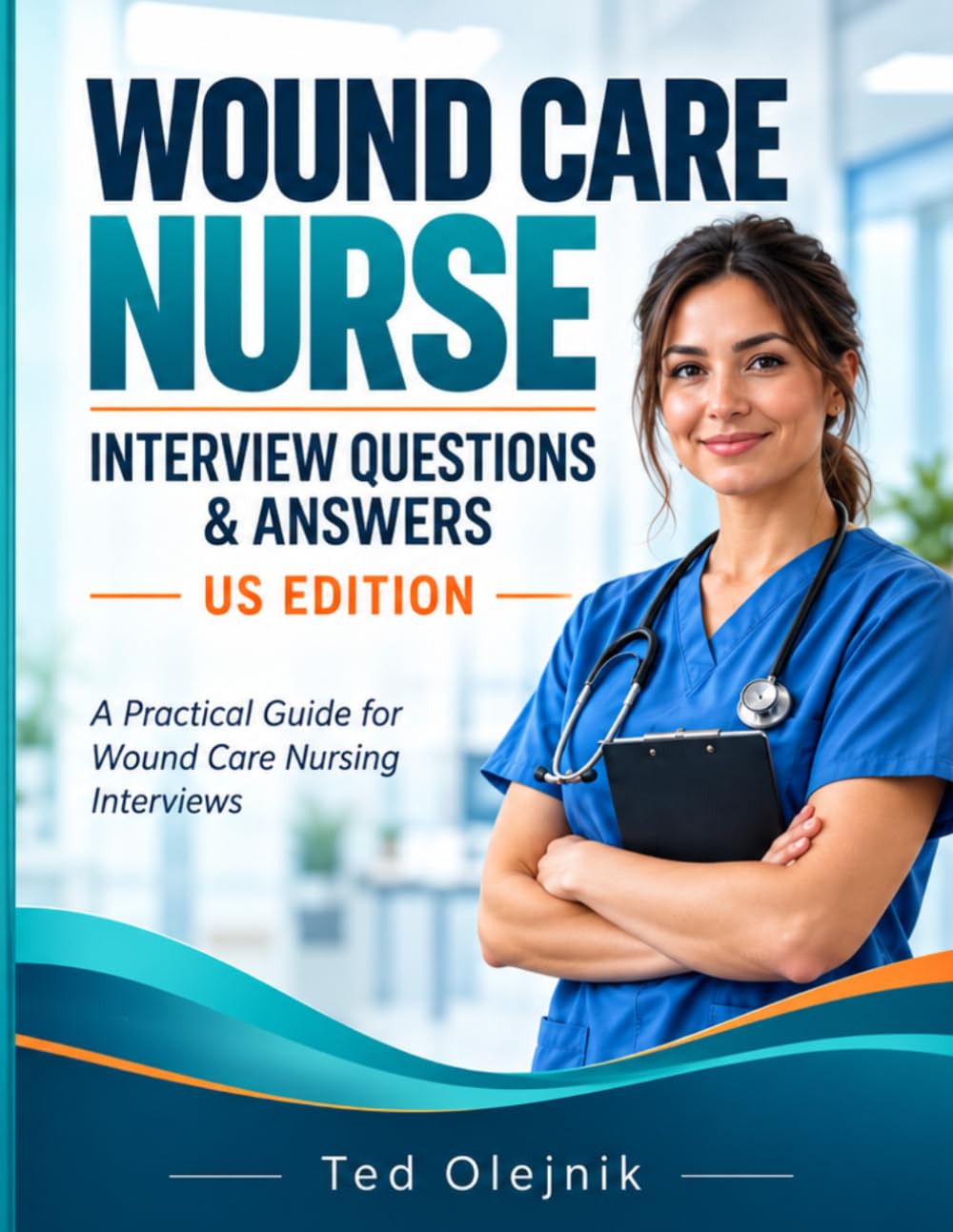
Wound Care Nurse Interview Questions & Answers US Edition
A practical interview-preparation guide with 220 questions, strong model answers, clinical scenarios, recruiter insights, and five complete mock interviews.
by Ted Olejnik
This is the US paperback edition. Check the Amazon listing for current pricing and availability.
Wound care nurse interview questions and answers: prepare to explain safe clinical decisions
A wound care nurse interview is not a dressing-product quiz. US hiring managers may ask how you recognize a limb-threatening change, distinguish pressure injury from moisture-related damage, assess a diabetic foot wound, document deterioration or respond when an advanced treatment is outside your validated competency. Wound Care Nurse Interview Questions & Answers — US Edition by Ted Olejnik is a 195-page preparation guide built around those questions.
The book contains 220 interview questions with model answers, recruiter commentary, common mistakes and follow-up questions, plus five complete mock interviews. It is designed to help candidates explain not only what they would assess, but why the finding matters, what they can do within their scope and when additional medical or specialist evaluation is required.
What is inside the 195-page wound care nurse interview guide?
- 220 questions and model answers: career fit, specialist competence, clinical assessment, safety, teamwork, leadership and prioritization.
- Pressure injury assessment: identification, staging, prevention, deep tissue injury, heel protection and avoiding confusion with moisture-associated damage.
- Lower-extremity wounds: venous, arterial and mixed-etiology wounds; vascular assessment; and compression precautions.
- Diabetic foot safety: neuropathy, perfusion, infection concerns, offloading, patient education and timely interdisciplinary referral.
- Advanced wound care concepts: debridement boundaries, dressing selection, negative pressure wound therapy and escalation for unexpected bleeding or tissue risk.
- Real nursing responsibilities: pain management, wound measurement, clinical photography, EHR accuracy, HIPAA, discharge planning, staff education and quality improvement.
- Five setting-specific mock interviews: acute-care hospital, outpatient wound clinic, skilled nursing/long-term care, home health and an RN transitioning into wound care.
- Interview preparation tools: a seven-day plan, practical checklists, STAR worksheet, questions to ask employers and a 30–60–90-day starting plan.
Sample wound care nurse interview questions and strong-answer reasoning
These previews are condensed, edited summaries of questions and model answers in the manuscript. They are educational interview examples, not a substitute for a patient-specific assessment, order or clinical protocol.
1. Why is vascular assessment important before compression therapy?
What a good interview answer demonstrates: edema does not automatically mean a wound is purely venous. Compression can support healing in appropriate venous disease, but the nurse must consider arterial perfusion, clinical findings, prescribed treatment and facility requirements. Abnormal or unreliable vascular findings call for qualified evaluation, while new rest pain, coolness, pallor or neurologic change requires urgent escalation. The panel is looking for limb-safety reasoning, not a favourite compression product.
2. How would you recognize a possible deep tissue pressure injury?
What a good interview answer demonstrates: look for persistent deep red, maroon or purple discoloration, a blood-filled blister or other findings consistent with deeper tissue injury, considered alongside the patient and skin context. Document the assessment, respond to pressure and shear risks and reassess. Avoid automatically labelling every sacral lesion as a Stage 2 pressure injury; moisture-associated skin damage, skin tears and other causes need to be distinguished appropriately.
3. What should you assess before negative pressure wound therapy (NPWT)?
What a good interview answer demonstrates: confirm the reason for therapy, wound anatomy, bleeding risk, vulnerable exposed structures, perfusion, infection status and system-specific precautions. The nurse should know what is covered by validated competency, the prescription and product instructions. Unexpected bleeding or concern about an exposed structure should trigger prompt clinical reassessment rather than routine device troubleshooting.
Clinical scenario: a wound patient develops a suddenly cold, painful foot
Interview scenario: A patient with a lower-leg wound develops a cold, pale foot, severe pain and reduced movement. What would you do first?
Strong-answer approach: explain that this may represent acute, limb-threatening perfusion compromise. Identify the new change and onset, arrange immediate emergency or vascular escalation according to the setting, and perform a rapid focused neurovascular assessment without delaying definitive evaluation. Avoid treating it as an ordinary dressing change. The interviewer is testing whether you prioritize limb safety over routine wound tasks.
Five mock interviews for different US wound care roles
The practice interviews cover an acute-care hospital wound nurse, an outpatient wound clinic nurse, a skilled nursing or long-term care wound nurse, a home health wound care nurse and a registered nurse transitioning into wound care. Each setting changes the resources available, the likely interview questions and the urgency of clinical escalation. Practise the mock interview closest to the job description, then use the others to strengthen your judgment in unfamiliar situations.
Who should use this US interview-preparation guide?
Registered nurses applying for wound care or wound consultation roles, experienced wound care clinicians preparing for a new employer, and RNs transitioning from medical-surgical nursing, critical care, post-acute care or home health. The book emphasizes honest credential descriptions, state-specific scope of practice, competency validation and adapting model answers to your own experience rather than memorizing somebody else's story.
Edition, author and Amazon US ordering
Official paperback: WOUND CARE NURSE INTERVIEW QUESTIONS & ANSWERS US EDITION: A practical interview-preparation guide with 220 questions, strong model answers, clinical scenarios, recruiter insights, and five complete mock interviews. Author: Ted Olejnik. ASIN: B0HHZLCHGD. Catalogue price: $22.99 paperback. Check Amazon US for live pricing, delivery and availability.
View Wound Care Nurse Interview Questions & Answers on Amazon US