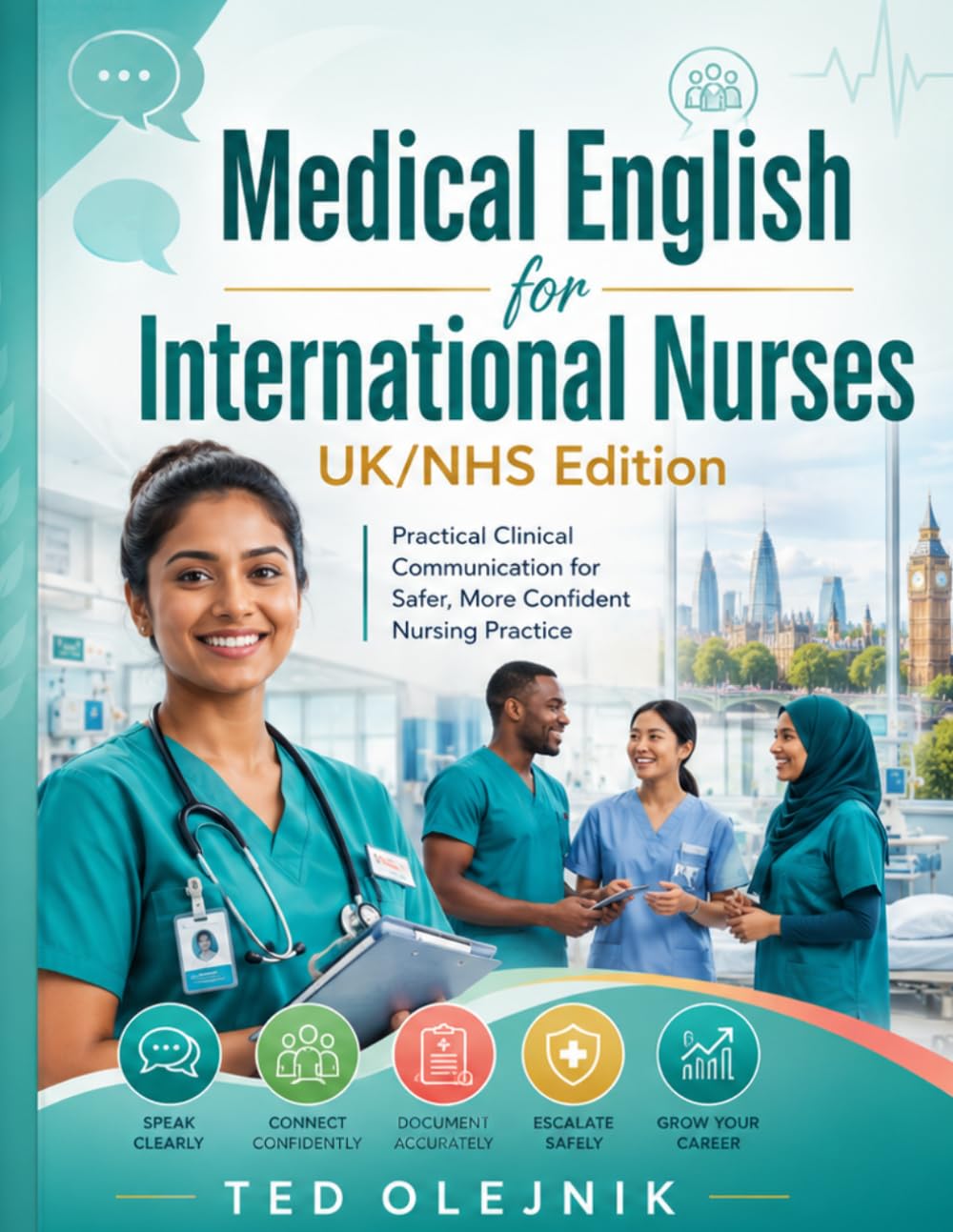
Medical English For International Nurses UK/NHS Edition
Practical Communication for Patient Care, Handover, Documentation, Escalation and Everyday NHS Practice
by Ted Olejnik
This is the UK paperback edition. Check the Amazon listing for current pricing and availability.
Medical English for international nurses: practise the conversations that matter in UK healthcare
Knowing what a patient needs is only one part of nursing. An internationally educated nurse must also understand how British patients describe symptoms, report a changing condition without ambiguity, document the facts and ask for urgent help when needed. Medical English for International Nurses — UK/NHS Edition by Ted Olejnik is a practical 174-page communication resource for those everyday challenges.
This is not simply a medical vocabulary list. The workbook distinguishes the language you use with a patient, the language you use in a clinical handover and the precise, objective wording required in a nursing record. It also addresses the uncertainty that arises when an accent, informal expression or hurried telephone call makes an important detail difficult to understand.
What the 174-page UK/NHS edition covers
- 18 practical chapters covering conversations with patients, colleagues and the multidisciplinary team.
- British patient expressions: how to clarify phrases such as “I had a funny turn,” “I feel sick” and “my waterworks aren't right” without assuming a diagnosis.
- Patient assessment language: asking about symptoms, pain, medicines, allergies, personal care, mobility and investigations.
- Communication during deterioration: explaining changing observations, using SBAR and asking clearly for the response you need.
- Clinical handover and documentation: translating a spoken concern into a concise handover and an accurate, time-specific nursing entry.
- Telephone communication: bleeps, read-back, confirming numbers and doses, and closing the loop on urgent requests.
- Professional communication: consent, privacy, safeguarding, sensitive conversations and working with interpreters.
- Practical learning resources: NHS phrase bank, abbreviations, model responses, integrated scenarios, 100 quick communication drills and a 30-day practice workbook.
Three practical medical English examples from the book
The examples below are shortened from the supplied manuscript for preview purposes. They illustrate communication skills, not clinical protocols or prescribing guidance.
1. A patient says: “I had a funny turn.” What should a nurse ask?
In everyday British English, funny turn may refer to nearly fainting, losing consciousness, palpitations, confusion or another event. The nurse should clarify exactly what the person experienced: what happened first, whether consciousness was lost, whether anybody witnessed it, how long it lasted and how the patient felt afterwards. The important skill is to turn an informal phrase into accurate clinical information, rather than documenting a guessed diagnosis.
2. How can you make an urgent SBAR call more useful?
The book contrasts an apologetic but vague request with a call that names the patient, the change and the required action. One practice example describes a patient's breathing worsening over 20 minutes while NEWS2 rises from 2 to 7. Instead of saying someone should look when available, the nurse identifies the concern and requests an urgent medical review. Situation, Background, Assessment and Recommendation are used to communicate the relevant details—not to produce a long scripted monologue.
3. What is the difference between patient English and documentation English?
To a patient, you may say: “I need to check your blood pressure again because it was lower than usual.” In a handover, you would specify the blood-pressure trend and associated symptoms. In the record, you would document the actual observation, when it was taken, the patient's report, what you did and whom you contacted. The clinical facts stay the same, but the register changes to suit the listener or reader.
How this NHS communication workbook helps you practise
- Read one short dialogue and identify the words that carry the clinical meaning.
- Speak it aloud to practise a clear, natural pace rather than memorising a perfect accent.
- Change the patient details so you must respond to a new situation.
- Summarise the interaction in ten seconds and check whether the action and timing are clear.
- Use the practice scenarios to check your handover, documentation and escalation language.
The workbook also includes a self-assessment, a high-value NHS phrase bank, a set of 100 short communication drills and a structured 30-day plan for repeated practice. The learning goal is not flawless grammar: it is clear, respectful, clinically meaningful communication and the confidence to ask for clarification when information is unsafe or incomplete.
Who is the UK/NHS edition for?
Internationally educated nurses preparing to work in the United Kingdom, nurses building confidence during induction or preceptorship, and healthcare professionals who want to practise British clinical English for patient care, escalation and handover. The book supports communication practice; it does not replace supervised clinical education, current NMC requirements or local NHS policies.
Edition, author and ordering
Official paperback: MEDICAL ENGLISH FOR INTERNATIONAL NURSES UK/NHS EDITION: Practical Communication for Patient Care, Handover, Documentation, Escalation and Everyday NHS Practice. Author: Ted Olejnik. Market: UK. ASIN: B0HG994PNC. Catalogue price: £18.99 paperback; Amazon UK provides current price and availability.