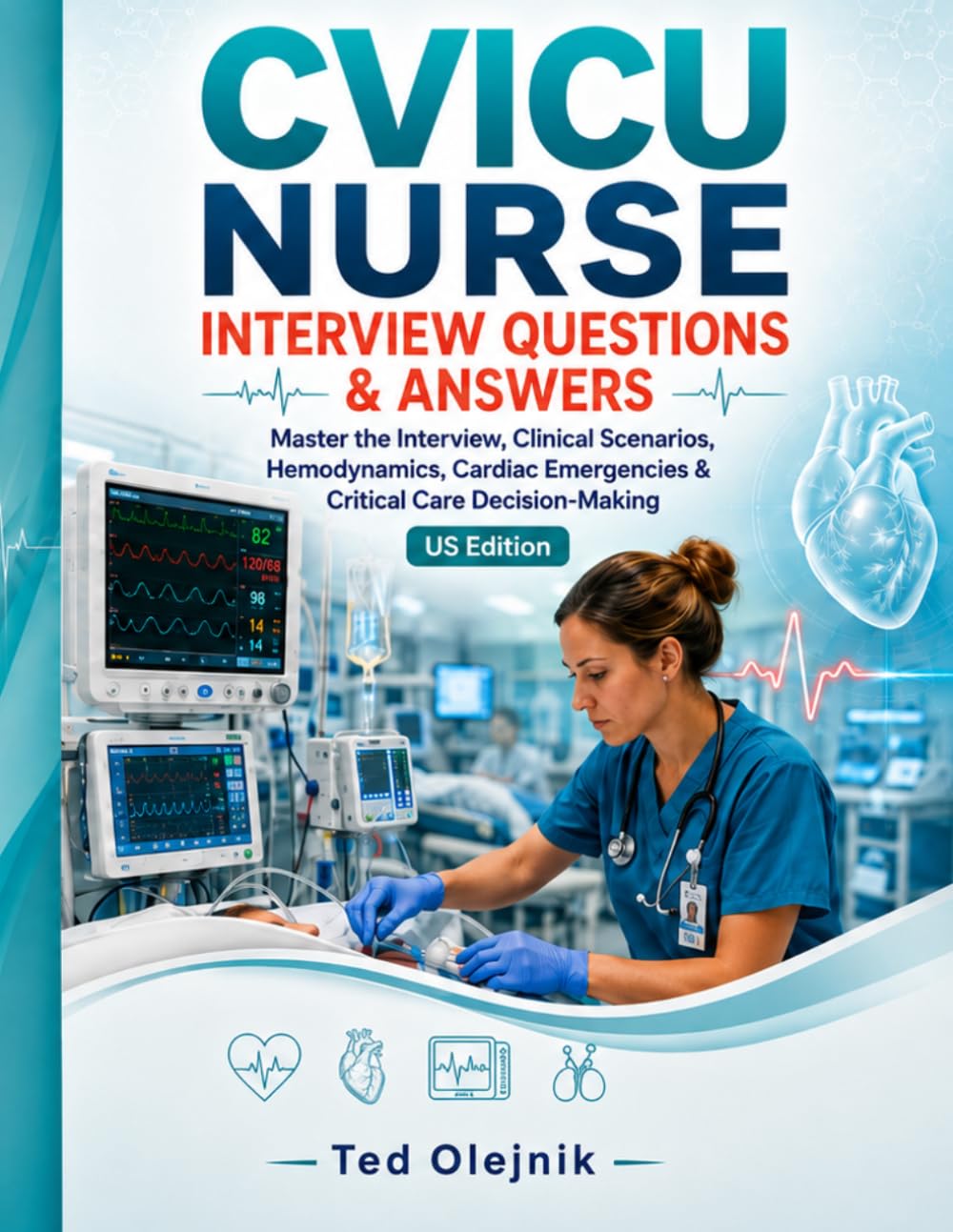
CVICU Nurse Interview Questions & Answers
Master the Interview, Clinical Scenarios, Hemodynamics, Cardiac Emergencies & Critical Care Decision-Making US Edition
by Ted Olejnik
This is the US paperback edition. Check the Amazon listing for current pricing and availability.
CVICU nurse interview preparation: show how you think, not just what you remember
Preparing for a cardiovascular intensive care unit interview requires more than rehearsing general nursing answers. CVICU panels may ask you to connect changes in blood pressure, cardiac output, rhythm, chest drainage, tissue perfusion, and device support to the patient's immediate priorities. This US-edition interview guide helps registered nurses explain that clinical reasoning clearly, without pretending that one number tells the entire story.
Written for nurses interviewing for CVICU roles, including clinicians transitioning from other acute and critical-care settings, the book pairs interview questions with strong model responses, recruiter insights, and common mistakes. Its central emphasis is on recognizing deterioration, knowing the limits of independent nursing action, communicating concerns, and escalating promptly when indicated.
What's inside this 190-page CVICU interview guide?
- 294 numbered interview and prioritization questions covering general, behavioral, clinical, postoperative, and experienced-nurse topics.
- 16 developed clinical scenarios that ask what the nurse would assess, prioritize, communicate, and do next.
- 5 mock interviews for new-to-CVICU candidates, ICU-to-CVICU transitions, experienced nurses, high-acuity clinical questioning, and a combined behavioral/clinical final round.
- Hemodynamics and perfusion: MAP, cardiac output and cardiac index, preload, afterload, CVP, arterial waveforms, lactate trends, and reasons the patient's condition may not match the monitor.
- Postoperative cardiac surgery: CABG and valve surgery, concerning chest drainage, suspected tamponade, temporary pacing, postoperative bleeding, and low-output patterns.
- High-acuity medication and device concepts: vasoactive support, IABP, Impella, VA ECMO, LVAD, device alarms, and when specialist support is needed.
- Other CVICU priorities: arrhythmias, ventilation and ABGs, renal and neurologic complications, escalation, handoff, teamwork, and medication safety.
Sample CVICU interview questions and model-answer reasoning
These short examples are editorial summaries adapted from questions and model answers in the manuscript. They are a preview of the book's interview-preparation approach, not clinical treatment instructions.
1. What could a rising CVP with falling blood pressure suggest?
Strong-answer approach: First verify both trends and assess the patient rather than naming a diagnosis from one measurement. Consider rhythm, perfusion, recent procedures, chest drainage, and evidence of impaired forward flow. The pattern can raise concern for right ventricular failure, tamponade, or another obstructive or filling problem. Explain why the combination needs timely escalation and team evaluation.
2. Why can a sudden stop in chest tube drainage be dangerous after cardiac surgery?
Strong-answer approach: The absence of new drainage does not automatically mean bleeding has stopped. In a patient who previously had ongoing output, assess the drainage system and the patient's hemodynamic trend for signs of obstruction or retained blood. If perfusion worsens, recognize possible postoperative tamponade and involve the cardiac surgery team urgently. Do not propose aggressive tube manipulation outside institutional policy.
3. What can cause an Impella suction alarm?
Strong-answer approach: Connect the alarm to the patient's condition and device information. Possible causes discussed in the book include inadequate left ventricular filling, right ventricular failure, or device malposition. Describe the assessment and trained support you would seek; avoid assuming that every suction alarm should be treated with an automatic fluid bolus.
A realistic prioritization question from the book
Which patient would you assess first? One patient has a MAP of 63 on stable low-dose vasopressor support, is alert, and has adequate urine output. Another has a MAP of 72 but is newly confused, cool, and making very little urine.
Model reasoning: Assess the second patient first. Despite the higher MAP, the change in mental status, cool skin, and low urine output may indicate inadequate tissue perfusion. The interview tests whether you recognize a deteriorating patient instead of treating a reassuring-looking number as proof of stability.
How to use this guide before your CVICU nursing interview
- Start with questions that fit your experience and the hospital's CVICU patient population.
- Practise your answers aloud: verify the finding, describe the bedside assessment, connect the evidence, act within your role, escalate appropriately, and reassess.
- Prepare genuine examples for conflict, advocacy, early deterioration, teamwork, and learning from feedback. Adapt model answers to your own experience rather than memorizing a script.
- Finish with a mock interview and targeted review of hemodynamics, cardiac surgery, or mechanical support topics that feel least familiar.
Who is this book for?
US registered nurses preparing for a CVICU interview, including experienced cardiovascular ICU nurses and nurses moving from MICU, SICU, telemetry, cardiac step-down, PACU, or the emergency department. The book differentiates interview preparation from independent device competence: it is not a substitute for clinical training, hospital orientation, unit protocols, or provider orders.
Edition, author and paperback ordering
Official KDP title: CVICU NURSE INTERVIEW QUESTIONS & ANSWERS: Master the Interview, Clinical Scenarios, Hemodynamics, Cardiac Emergencies & Critical Care Decision-Making US Edition.
Author: Ted Olejnik. Market: United States. Paperback ASIN: B0HFDGRDG5. The listed catalogue price is $21.99; check Amazon US for live price, delivery and availability.